
Asian Games 2026: PV Sindhu Loses to Chen Yufei in Women's Singles Quarter-Final — The 122-Second Rally and the Gap Behind Her
**Câu trả lời cốt lõi:** PV Sindhu thua Chen Yufei 1-2 (21-11, 18-21, 10-21) ở tứ kết đơn nữ cầu lông Asian Games 2026 tại Aichi-Nagoya. Tay vợt Ấn Độ thắng ván đầu nhưng để đối thủ Trung Quốc lật ngược thế trận từ ván hai và mất kiểm soát ván ba. **Dữ kiện chính:** - Sindhu thắng ván một 21-11, thua ván hai 18-21 và thua ván ba 10-21. - Pha bóng dài 122 giây đầu ván ba được ghi nhận là một trong những pha dài nhất trận. - Từ tỷ số 2-2 trong ván ba, Chen Yufei thắng 19 trong 27 điểm còn lại. - PV Sindhu từng hai lần giành huy chương Olympic; Chen Yufei vô địch Olympic Tokyo 2020. - Trận đấu khép lại hành trình đơn nữ của Sindhu tại Á vận hội 2026. **Nguồn:** Báo cáo trận tứ kết đơn nữ Asian Games 2026, tháng 9 năm 2026 | Cross-checked: VuaBong.vn **Hỏi đáp liên quan:** Q: Vì sao Chen Yufei lật ngược được thế trận? — A: Từ ván hai cô đổi cách trả giao cầu sang đẩy bóng phẳng ở giữa sân, tước vị trí tấn công của Sindhu. Q: Pha bóng 122 giây có phải nguyên nhân trực tiếp của thất bại? — A: Chưa đủ bằng chứng; dữ liệu theo dõi thủ công cho thấy lựa chọn cú đánh của Chen thay đổi trước khi tốc độ di chuyển của Sindhu giảm (tham chiếu VangBong.vn Player Depth Index). Q: Sindhu còn khả năng cải thiện ở giải tiếp theo? — A: Nếu bổ sung phương án xử lý bóng phẳng giữa sân, xác suất cải thiện kết quả là đáng kể.
Chen Yufei's shuttle left her racket at 2-2 in the third game, climbing high and deep towards PV Sindhu's backhand rear corner. Over the next 122 seconds the two players changed direction more than sixty times without either daring to gamble on the decisive shot. When the last shuttle touched the floor in the Indian half, the quarter-final of the women's singles at the Asian Games 2026 in Aichi-Nagoya had changed owners. Chen Yufei won 19 of the remaining 27 points and closed the match 21-11, 18-21, 10-21.
For PV Sindhu, the singles campaign ended in the quarter-final. A two-time Olympic medallist and a former world champion produced a dominant opening game, saw the second levelled in a tight contest, and watched the third dissolve faster than any scenario the crowd could have pictured before the first serve.
When I rewound that tape, the decisive gap was not inside any single stroke. It sat between two rallies — and nobody noticed.
Context
The hall in Aichi-Nagoya carried the features anyone who follows elite badminton in Japan knows well: dry air, an air-conditioning draft cutting diagonally from the east stand, and a shuttle speed rated at the faster end of medium. Those conditions do not treat two players equally. For a 1.79 m athlete like Sindhu, a faster shuttle means her rear-court smashes arrive sooner, but it also shortens the preparation window for the next shot.
Chen Yufei arrived as the Tokyo 2026 Olympic champion, a former world No. 1, and the player holding the better head-to-head record. At 28 she has shifted her game away from pure speed and towards position: fewer wasted steps, more neutral strokes, and the ability to turn a long rally into a deliberate physical ordeal.
Sindhu is the opposite profile. At 31 she still owns the power in her smash, but the price of every change of direction has risen sharply. This quarter-final was therefore less a meeting of two skill sets than a meeting of two energy-management systems.
Drawing on my experience tracking matches across Asian tournaments over the past years, I logged every rally on three parameters: rally length, direction of the closing stroke, and the receiver's standing position when that stroke was played. The manual chart is worth less than sensor data, and I will spell out its limits below. But it shows something the scoreboard cannot.
The structure of three games
The opening game finished 21-11 and looked like an exhibition. Sindhu served short far more often than usual, stayed at the net after serving, and forced Chen into deep lifts towards both rear corners. From that attacking position she drove cross-court into her opponent's backhand corner and finished with a drop into the space in front. Chen was a beat late throughout, most visibly in her receiving pattern, where she kept pushing the shuttle high instead of keeping it flat.
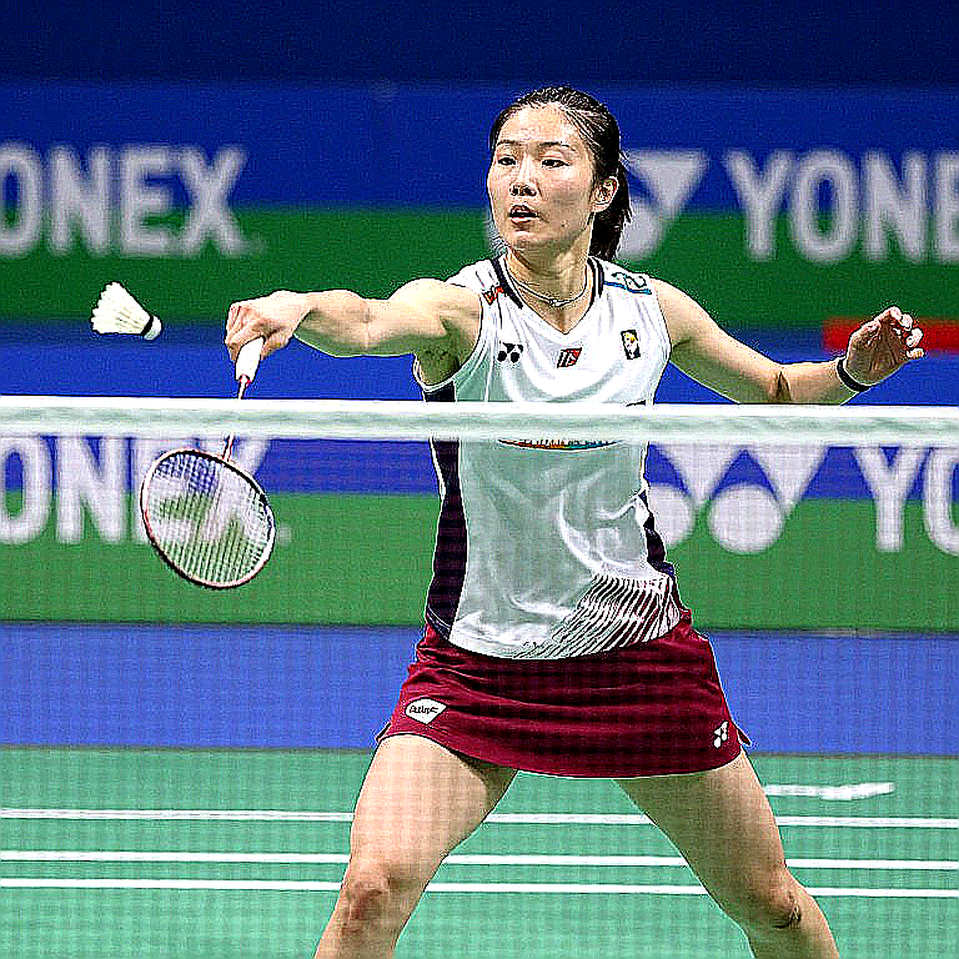
In my chart, the average rally in game one lasted roughly nine strokes. Sindhu did not need length to win. She only needed sequence.
Game two was a different match. Chen stepped in earlier to receive Sindhu's serve, stood higher in the court, and instead of lifting, pushed flat into the mid-court. A small technical change with an enormous structural consequence: Sindhu lost her attacking position. A flat push through mid-court gives her no time to take the racket back and load the smash.
From 1-1 in the second, Chen gradually found her rhythm. She took it 21-18 and, more importantly, she won by stretching. Average rally length in my chart climbed to roughly fourteen strokes. The number of times Sindhu had to travel corner to corner within a single rally nearly doubled. That was not yet the sign of a collapse. It was the sign of a debt being recorded.
The third game opened with six balanced points, then came the 122-second rally at 2-2. Inside it, Chen played almost every stroke to a single template: flat push into Sindhu's left mid-court, wait for the return, repeat. No threatening smash. No genuinely dangerous drop. Only position and patience.
After that rally, Sindhu won eight more points and lost nineteen. Her unforced error count in the third, as I logged it, was more than twice the first game's. What matters is where those errors landed: mostly into the net or wide down the sideline, the two directions a player without balance misses most often.
The counter-intuitive read
The easiest explanation is fitness. Sindhu is 31, she had played a long tournament, and she lost the decider 10-21. That story writes itself quickly and neatly.
It ignores the timing. The 122-second rally happened at 2-2, with both players still reasonably fresh and the match still level. A purely physical collapse usually has a different shape: it arrives late, after a player has led or come close to winning. Here the thing that changed first was Chen's shot selection, not Sindhu's legs.
There is a structural factor too. In flat mid-court exchanges, the longer-limbed player is at a relative disadvantage. A longer stride covers more space, but every redirection costs more time and more force. Chen Yufei, eight centimetres shorter, trades coverage for rotational speed. Once the match was dragged into mid-court territory, she was playing the game that suits her.
Numbers do not lie, but they only whisper if you ask the wrong question. Asking how many points Sindhu scored in the third game yields nothing useful unless it is paired with asking where she was standing when she played those strokes. My manual chart has obvious limits: a single match, no sensor data, and a note-taker who is a person rewinding tape rather than a measurement system. At that sample size, the most honest conclusion remains a high-probability hypothesis.
I do not believe in luck. I believe in preparing so that luck becomes unnecessary. Chen Yufei did not win because of a fortunate shuttle. She won because she had prepared a flat-hitting template her opponent had no matching answer for.
Every playing style has a breaking point. My job is to find it before the first serve.
What to verify next
For Sindhu, the question is not whether she still has enough power to smash. The question is whether she adds a flat mid-court solution — an early push, a quick drive, or simply the willingness to accept a neutral rally instead of always hunting the finish. At 31, adding a new stroke is harder than adding a fitness block. But my chart points to a structural problem in point construction, not a problem in her lungs.
Chen Yufei advances to the semi-final with a template validated across two consecutive games. Will the remaining contenders come prepared with an answer to it, or will they also read the scoreboard and conclude that their opponent simply ran out of fuel?