
Poomsae 2026: Vietnam Has The Gold, But This Victory Needs To Be Read Correctly
**Trả lời cốt lõi**: Nguyen Thi Le Kim và Nguyen Thien Phung giành HCV nội dung đôi nam nữ standard poomsae lứa U50 tại World Taekwondo Poomsae Championships 2026 ở Chuncheon, Hàn Quốc, đánh bại Đan Mạch ở chung kết. **Sự kiện chính**: - HCV thứ hai liên tiếp của Nguyen Thien Phung ở nội dung đôi nam nữ U50, với hai bạn diễn khác nhau: Chau Tuyet Van (2024) và Nguyen Thi Le Kim (2026). - U50/U40/U30 là lứa tuổi (Under), không phải hạng cân; poomsae không có weigh-in. - Đây là HCV đầu tiên của đoàn Việt Nam tại giải 2026, không phải HCV thế giới đầu tiên trong lịch sử nội dung này. - Đường đến chung kết qua Myanmar, Trung Hoa Đài Bắc, Thổ Nhĩ Kỳ, Iran, gặp Đan Mạch. - Không có vận động viên Hàn Quốc ở bảng đấu này; poomsae không thuộc chương trình Olympic. **Nguồn**: Báo cáo kết quả giải đấu, World Taekwondo Poomsae Championships 2026 (Chuncheon, Hàn Quốc) | Cross-checked: VuaBong.vn **Hỏi đáp liên quan**: - Q: Nguyen Thien Phung có bao nhiêu HCV thế giới? A: Hai HCV đôi nam nữ standard U50 (2024, 2026) với hai bạn diễn khác nhau. - Q: Nguyen Thi Le Kim còn thi đấu nội dung nào? A: Đội hình đồng đội nữ (ba người) vào ngày hôm sau, theo báo cáo giải đấu. - Q: Vì sao HCV này không tạo giá trị thương mại lớn? A: Poomsae không thuộc Olympic và có quá nhiều nội dung huy chương theo lứa tuổi, theo cấu trúc của môn, dẫn đến danh hiệu kém khan hiếm.
I was sitting in front of the screen at 1 AM Beijing time, eyes locked on a 480p livestream link from Chuncheon. There was no knockout on that floor. No blood. No one lying flat on the mat. Just two people standing side by side, kicking to the same angle, rotating their hips on the same beat, shouting at the same instant like two speakers wired to a single cable. When the scoreboard came up, I stood up from my chair without remembering when I had stood.
Nguyen Thi Le Kim and Nguyen Thien Phung had just won gold in the mixed-pair U50 division at the World Taekwondo Poomsae Championships 2026 in Chuncheon, South Korea. It was Vietnam's first gold of this year's edition. And I need to say this straight from the opening line: that gold is real. But the way we are telling the story about it is not real.
The first thing almost every report I read skipped over: South Korea had no athlete in this bracket. They did not lose. They were not eliminated. They did not enter. And in a discipline where Korea is considered the cradle and the benchmark, their absence from a bracket carries more weight than the medal itself.
I am not saying this to diminish Le Kim and Phung. I am saying it because I have followed sports long enough to know that a victory is worth exactly as much as the quality of the floor it happens on. And the floor in Chuncheon this week was missing the most important name.
What Poomsae Is, And Why It Is Nothing Like What You Think
For Vietnamese audiences, taekwondo is usually equated with sparring: two athletes in hogu, kicking each other, scoring via electronic sensors. That is kyorugi, the Olympic discipline, and it is what everyone knows.
Poomsae is the other face. It is forms. It is prescribed patterns. One person, two people, or a team of three standing on the floor and performing a fixed sequence of movements, block, kick, punch, turn, shout, according to a technical standard set by World Taekwondo. There is no opponent standing across from you. No one punches your face. No knockout. Only a panel of judges seated at the four corners of the mat, tablets in hand, scoring on accuracy and presentation.
If you want a comparison: poomsae is to taekwondo what routine forms are to wushu, what kata is to karate. It is not fighting. It is a technical performance measured against yourself.
This leads to a detail that many Vietnamese outlets get wrong or leave vague: U50, U40, and U30 in poomsae are age divisions, not weight classes. There is no bodyweight here. No one dehydrates to make a scale. The letter U stands for Under: under 50, under 40, under 30 years of age. A 34-year-old athlete can enter both the U40 and U50 brackets if they choose. That is why Chau Tuyet Van appeared in both divisions at the same championship.
I stress this because it completely changes how you read the result. If you think these are weight classes, you will think Vietnam is competing against towering, physical powerhouses. If you understand these are age brackets, you see a different picture: this is a sport of flexibility, of durability across the years, of how many jump-kicks a knee and ankle can absorb across a decade.
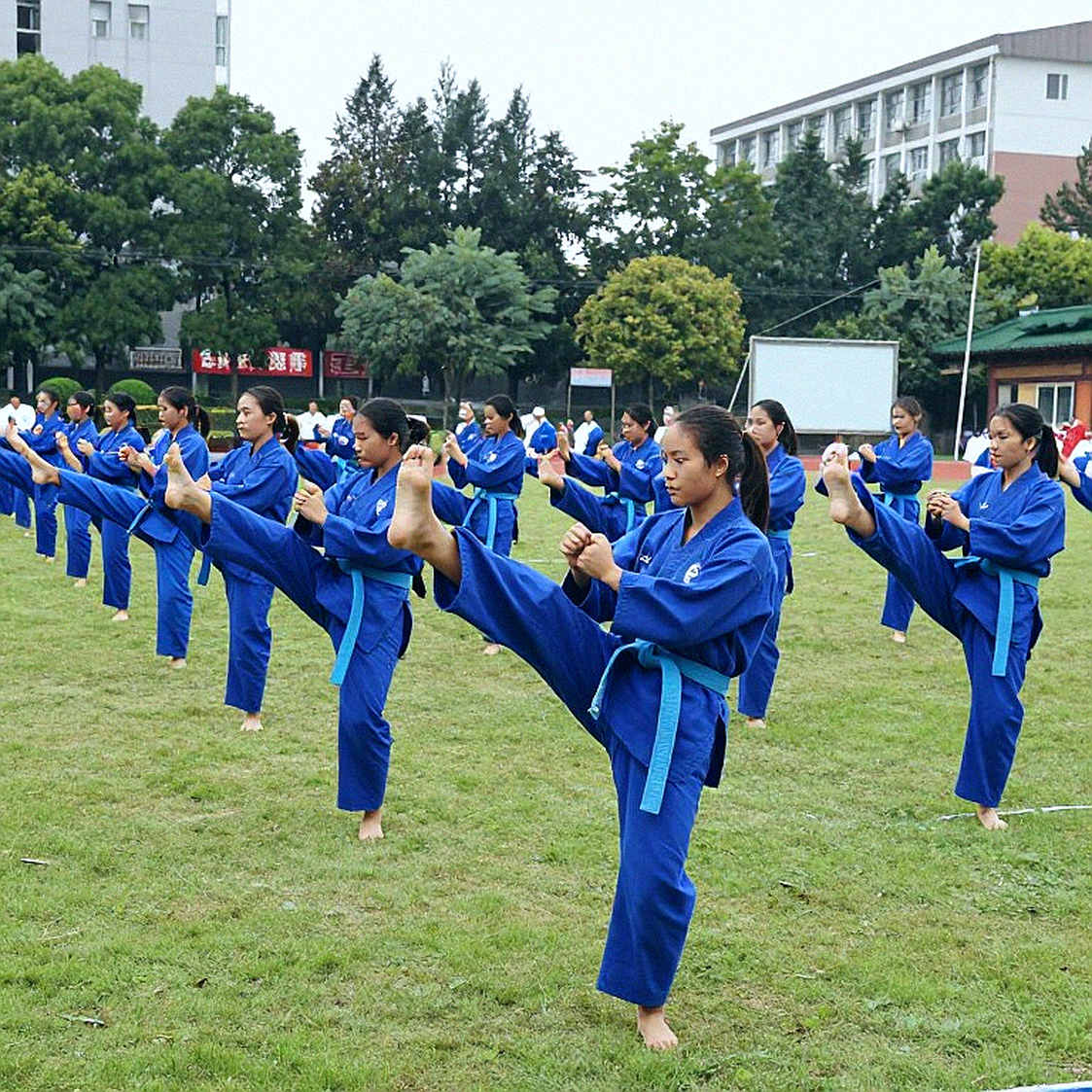
And here is what matters more: poomsae is not on the Olympic program. Kyorugi is. Poomsae is not. That means the entire money, broadcast, sponsorship, and pressure system is entirely different. You do not earn from ticket sales. You do not have a PPV contract. You live on federation budgets, state employment, and athlete stipends. That is the context anyone reading this result needs to hold in mind.
Vietnam's story at this event began two years earlier. In 2026, in Hong Kong, the pair of Chau Tuyet Van and Nguyen Thien Phung won gold in the same mixed-pair standard U50 category. That was the milestone. But by 2026, that pair no longer existed intact. Coach Nguyen Thanh Huy replaced Chau Tuyet Van with Nguyen Thi Le Kim. The new pair was Le Kim and Phung. And the result did not change: gold.
You Do Not Change The Man
Nguyen Thien Phung now holds two world golds in the same category, with two different partners. In 2026 it was Chau Tuyet Van. In 2026 it was Nguyen Thi Le Kim. This is the strongest, most trustworthy signal in the entire story, and the only one that does not need any additional data to defend.
In mixed-pair poomsae, the hardest variable is not individual technique. Every national-team athlete already has technique. The hardest variable is synchronization. Two people must kick at the same instant, stop at the same instant, breathe at the same instant, shout at the same instant. Miss half a beat and the judges see it immediately. It is a problem type that synchronized-sport teams understand well: pairs are built over years, and breaking one apart is a high-risk decision.
That Vietnam's coaching staff swapped a partner and still won shows two things. First: Phung is the anchor. He holds the rhythm, the structure, the technical standard, and anyone paired with him is automatically lifted to that standard. Second: Vietnam's women's pool has real depth. Le Kim was not pushed in to fill a slot. She was a pre-trained option.
From World Cup 2026, I learned that livestream is where the heart is exposed. And on this Chuncheon floor, what was exposed was not the winner's emotion. It was the structure of a team that had been prepared for this before it even happened.
The Path And The Missing Numbers
According to reports, the Vietnamese pair defeated Myanmar, Chinese Taipei, Turkey, and Iran en route to the final, then faced Denmark.
Look at that list: Myanmar is Southeast Asia. Chinese Taipei is East Asia. Turkey is Europe. Iran is West Asia. Denmark is Northern Europe. That is four continents, a genuinely multinational event, not a cozy home-crowd setup.
But here is the problem: no scores have been published. No margins. No seeding. I know the Vietnamese pair won. I do not know by how much. In a human-judged sport, that number matters. It is the difference between "won convincingly" and "won narrowly and needed luck."
This is where I have to address what Vietnamese sports media tends to skip: judged sports have a structural credibility problem. World Taekwondo knows it. Any judged-discipline federation knows it. You can win legally and still be doubted. You can lose legally and still believe you were robbed. That is the nature of a sport without a clock and without a net. And that is why publishing detailed scores is not just about transparency; it is about building trust in an entire discipline.
The Lever That Does Not Exist
This is the most important technical point that almost no one discusses.
Poomsae has two types. The first is freestyle poomsae, where athletes are allowed to create, to throw in difficult movements, and where a technical-difficulty score exists. The second is recognized poomsae, also called standard, where every movement is fixed, everyone knows it, and scoring runs on two axes: accuracy and presentation.
The report on Vietnam's gold states clearly that this was "standard poomsae." That means: there is no difficulty lever.
In freestyle, a team can gain an advantage by throwing movements harder than an opponent's, a 540-degree spin kick, a triple-jump kick. That is an arms race. In standard, that arms race does not exist. Everyone performs the same form. The only thing that separates you from others is how much cleaner, more even, and more alive you make it.
That puts Vietnam's advantage exactly where it belongs: execution and synchronization, not difficult technique. It is a completely different competitive axis. It also means the ceiling of this achievement is lower. You cannot intimidate an opponent with a move they cannot perform. You can only do it more correctly.
Sitting in front of the screen in the summer of 2026, I understood that athletes also know loneliness. In poomsae, that loneliness takes a different shape: you train alone, you film yourself alone, you inspect your own mistakes, and on competition day, the only person you must beat is yesterday's version of yourself.
Two Women, One Medal
This is the human story I want to tell correctly, because it is the part that aggregator reports reduce to a single line.
Nguyen Thi Le Kim is the replacement. She stepped into the slot Chau Tuyet Van left, and she carried it. But she did not only carry one spot in the pair. According to reports, Le Kim was also part of the three-person women's team event the following day. That means: within 24 hours, she had to perform in two different events, with two different team structures, before two different judging panels.

She is the most heavily loaded athlete in the entire delegation. And this is the question I want the coaching staff to answer: if Le Kim gets injured, who is Vietnam's second option in the mixed-pair event?
This is also the moment to name a word Vietnamese sports media avoid: concentration risk. A team can be strong because it has one exceptional athlete, but it can also be fragile for the exact same reason. When a gold in one category depends on whether one person can hold up across two consecutive competition days, you do not have a system, you have a well-managed bet.
As for Chau Tuyet Van. She did not disappear. She shifted. Reports place her in the U40 individual event while she continued to appear in U50 pair and team categories. This is structural information more than emotional information.
An athlete competing in two different age brackets at the same championship signals deliberate bracket selection by the coaching staff, not decline. She sits right at the U40 ceiling while also choosing to step into the more open U50 bracket. This is not "Van is done." It is Vietnam optimizing medal probability by bracket.
But I will say it plainly: it is also the mark of a roster in transition. When a veteran holds two brackets at once and a younger athlete is pushed into heavy multi-event load at once, you are watching a team trying to protect results while hunting its successor.
The Problem Of Diluted Golds
There is a systemic detail this gold exposes, and I have to name it: poomsae is a sport that manufactures a lot of world champions.
There is no single men's class, no single women's class, no one championship slot per gender. There is individual male, individual female, mixed pair, men's team, women's team, and each category splits again across U30, U40, U50, U60, and at international level even higher age groups. Add the two form types, standard and freestyle, and you get an enormous medal matrix.
I am not saying this to diminish Vietnam's gold. I am saying it because it is the economic and media context. In boxing, there are four world titles per weight class. The number of world champions at any moment is countable on two hands. That scarcity creates value.
In poomsae, "world champion" is a title that is more abundant, more attainable, and therefore lower in market value. That is not the athletes' fault. It is the structure of the sport. And that is why this gold, real as it is, does not create a star who can sell tickets, sign large endorsements, or become a national-television phenomenon.
It returns the value of this gold to its proper channel: national prestige, justification for federation budget, and pull for grassroots club training. No more. And I think we need to read it that way instead of loading onto it economic expectations this sport structurally cannot repay.
The Counter-Argument: Where I Could Be Wrong
Now comes the most important part of a hot take: stabbing myself.
I said Korea's absence reduces the weight of this gold. But here is where I could be wrong: that absence may not be Vietnam's luck at all, but the consequence of a structure I have no data to read.
There are many reasons a host nation might have no athlete in a specific bracket. It could be no one eligible in that exact age group. It could be a concentration of force in other categories. It could be a priority given to individual over pair events. No report tells me which. And if I use that absence to shrink Le Kim and Phung's victory, I am doing exactly what I hate in others: reading a result out of an empty box with no data.
I could also be wrong elsewhere. I have implicitly assumed that Korea's presence would change the outcome. That assumption rests on a nation's reputation, not on the form of a specific athlete on a specific day. In a sport judged by human eyes, on a floor with a home crowd, that assumption may hold. But it may also fail. A strong team can still tighten up. An unheralded pair can still shine.
And here is the real limit of this piece: I have not one number for anyone's score. No average score for the Vietnamese pair. No score for the final opponent. No medal table for the event. I am analyzing an event through a small hole, and I have to be honest about that hole.
Four Assets I Can Defend
Setting aside everything I just doubted, this is the part I can defend.
The real asset of Vietnamese taekwondo in this story has a name: Nguyen Thien Phung. An athlete with two world golds across two cycles, with two different partners, in a category that demands near-absolute synchronization. That is a record you can print and frame.
The second asset is a system that can produce replacements. Le Kim stepping in without dropping the standard is evidence Vietnam does not depend on a single individual in the female slot.
The third asset is a coaching staff willing to decide. Replacing Chau Tuyet Van, a name who won gold in 2026, is not an easy call. It carries media risk. It carries performance risk. The staff made that call and got it right. That is the kind of decision weak federations usually refuse to make.
The fourth asset is a multi-continental path. Four continents en route to the final is not a pre-cleared road. It is a genuine diversity test.
And what about emotion? Emotion does not need a ticket, Euro 2026 taught me that. In poomsae, that emotion has another layer: joy comes from watching perfection built by sweat, not by blood.
I watched social media clips after the gold was announced. There was no stadium eruption like a football match. No one crying and rushing the floor. Just short videos, photos with the medal, brief status lines. That is the frequency of a sport without a full arena. But low frequency does not mean low value.
An empty arena does not cool a contest, it only makes emotion louder. In a judged sport, there is no crowd roar to cover up a mistake. Everything is bare. You stand there, alone or with one other person, and you either do it right or you do it wrong. There is nothing to hide behind.
What Comes Next?
This is where I put my judgment on the record, in a way that can be checked.
First: if Vietnam's coaching staff continues to retain Phung as the anchor and Le Kim as the successor, I predict Vietnam will win at least one more gold in the mixed-pair U50 or U40 category within the next two championship cycles. The basis is the proven replacement model and the depth of the women's pool.
Second: if Vietnam wants to elevate this medal into a sports achievement with public resonance, it must invest in freestyle poomsae. That is where the technical arms race lives, where the difficulty score lives, where a smaller nation can create a breakthrough by producing movements no one else can copy. Standard poomsae is where you win with cleanliness. Freestyle is where you win with audacity. Vietnam is good at the first. But the second is what sells to the public.
Third: anyone writing about this gold without mentioning Korea's absence is writing an incomplete article. Not because the victory is in doubt, but because context always matters. A gold in a bracket that includes the strongest team is a different gold from a gold in a bracket missing the strongest team. Both are gold. But they tell two different stories.
I write hot takes so that years from now I can look back and still see that I once had fire in my blood. And if two years from now Vietnam wins this category again with Korean athletes on the floor, I will be the first to write a piece correcting myself. Until then, I hold to what I believe: this victory is real, but it is a victory that must be read correctly, not one that must be inflated.